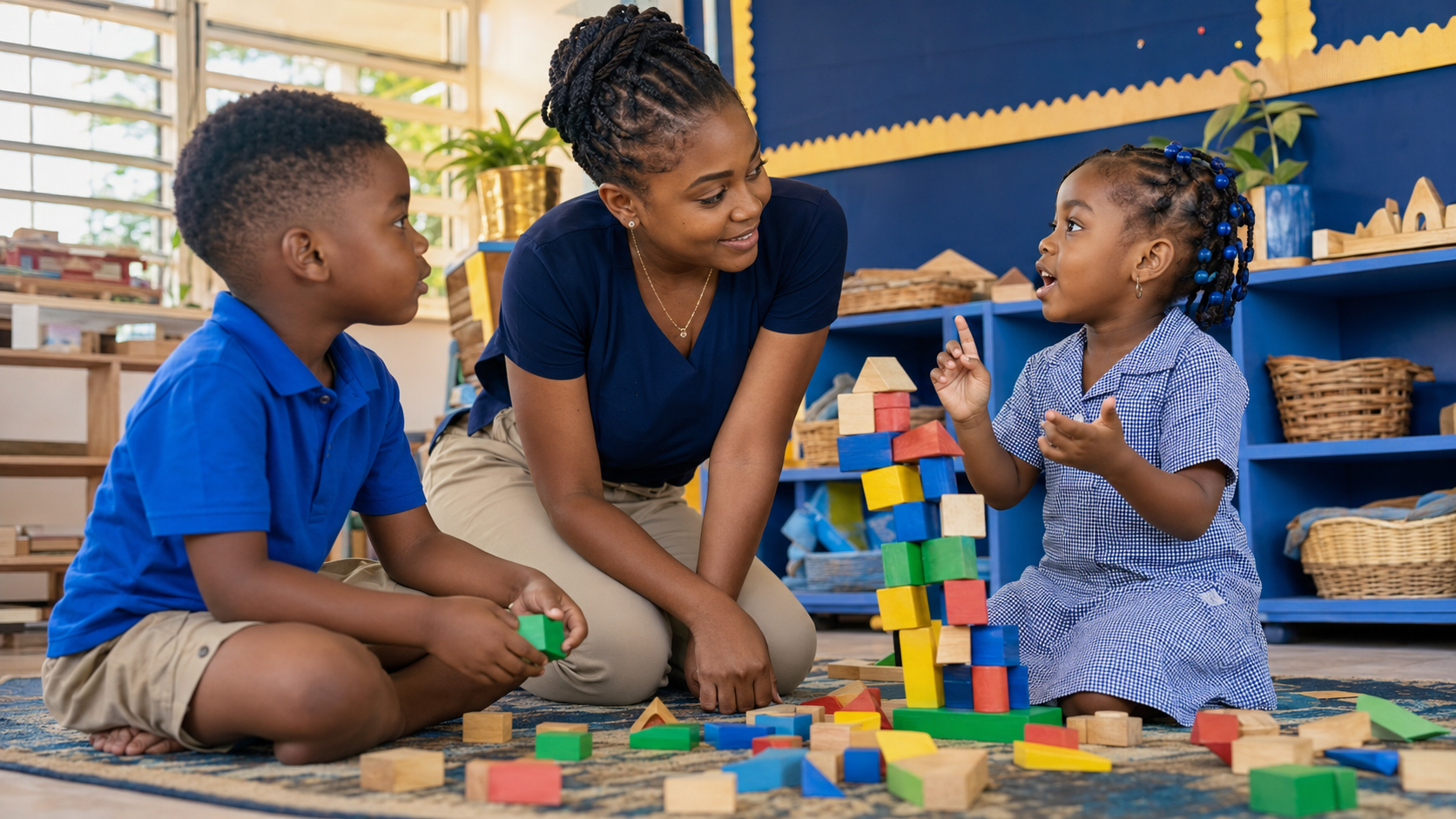
Ask Better Questions, Build Stronger Minds
How Open-Ended Questions Support Children’s Cognitive and Language Development
Young children do not develop thinking and language only by hearing information. They develop through interaction—by noticing, wondering, naming, explaining, negotiating, pretending, remembering and trying again.
A well-timed question can transform an everyday classroom moment into a language-rich learning experience. The words a practitioner chooses influence what a child pays attention to, how deeply the child thinks, and whether the response is limited to one word or grows into a confident explanation.
In early childhood, questions should not function mainly as tests. At their best, they are invitations to think, talk, connect and explore.
Key idea: The quality of the adult’s question influences the quality of the child’s thinking and the length, detail and confidence of the child’s response.
Why Questioning Matters to the Developing Brain
Early brain development involves the growth and organisation of systems used for movement, emotion, attention, memory, language, relationships and thinking. During the early years, the brain is highly responsive to repeated experiences and relationships. This does not mean children should be pushed into formal academics too early. It means they benefit from rich experiences—play, conversation, exploration, repetition, emotional safety and responsive interaction.
Repeated experiences strengthen learning pathways
A neural pathway is a route of connected brain cells used for a particular kind of thinking, movement, language or response. When a child repeatedly describes objects, predicts outcomes, retells stories or explains choices, the pathways supporting those skills become stronger and more efficient.
Healthy repetition in early childhood is not mechanical drilling. It happens naturally through songs, stories, routines, play and repeated opportunities to express an idea in different ways. A practitioner may ask, “What happened yesterday?”, “How is this tower like the one you built before?” or “What could we try again?”
Neuroplasticity creates opportunities for growth
Neuroplasticity is the brain’s ability to change and reorganise in response to experience. Young children’s brains are especially adaptable, making early childhood a powerful period for building language, attention, relationships and learning habits.
Children do not all develop at the same pace. A child who gives very short answers today may gradually build longer and clearer responses when adults offer patient encouragement, useful language models, sufficient wait time and repeated chances to speak.
Responsive relationships make conversation possible
Children learn more effectively when they feel seen, respected and emotionally safe. A practitioner who moves to the child’s level, watches carefully, listens and expands the child’s idea provides both emotional and language support.
This back-and-forth exchange is often described as serve-and-return interaction. The child “serves” through words, gestures, facial expressions, actions or attention. The adult “returns” by responding, naming, extending, comforting or asking a meaningful question.
Example: A child points to a snail. The practitioner responds, “You noticed the snail moving slowly. What do you think it is trying to do?” The adult follows the child’s interest while extending observation, prediction and vocabulary.
Emotional Safety Is Part of Effective Questioning
Fear, embarrassment, harsh correction and constant pressure can reduce a child’s willingness to speak, explore or attempt difficult thinking. Questions should therefore sound warm, curious and respectful. Their purpose is to help the child think—not to expose the child for being wrong.
Instead of asking, “Why did you do it wrong?”, try “What happened when you tried it that way?” or “What could we try next?” The revised wording lowers the threat and directs attention toward reflection and problem-solving.
Closed-Ended and Open-Ended Questions: Know the Difference
A question is a prompt that invites a response. In teaching, a question can check information, direct attention, stimulate thinking, invite language, reveal understanding or support reflection. The important issue is not whether a question is “good” or “bad”, but whether it matches the learning purpose.
Closed-ended questions
A closed-ended question usually has one known answer and may be answered with “yes”, “no”, a number, a label or a short phrase. Examples include “What colour is the cup?”, “How many blocks are there?” and “Is the scissors open or closed?”
These questions are useful for checking vocabulary, safety, memory, counting and factual understanding. The limitation appears when they dominate the conversation: children receive fewer opportunities to explain, reason and use extended language.
Open-ended questions
An open-ended question allows more than one reasonable response. It invites the child to explain, describe, predict, compare, imagine, reflect or solve a problem. Examples include “What do you notice about the tower you built?” and “How did you decide where to place that block?”
The child must organise an idea and communicate it in their own words. An open-ended question does not guarantee a long answer, but it creates space for one.
Seven Practices for Asking Better Questions
-
Begin with a clear purpose. Decide whether you want the child to notice, describe, predict, explain, solve a problem, reflect or express a feeling.
-
Connect the question to the child’s current experience. Questions are most meaningful when they emerge from what the child is doing, seeing or feeling.
-
Ask one clear question at a time. Several questions in one sentence can overload attention and expressive language.
-
Allow wait time. Pause, look interested and resist the urge to answer your own question. The child may need several seconds to process and organise words.
-
Accept different reasonable responses. Open-ended questions are designed to make room for the child’s interpretation, not one adult-approved sentence.
-
Use prompts without taking over the thinking. Pointing, gestures, pictures, choices and sentence starters can support a child who has an idea but needs help expressing it.
-
Listen and extend. Use the child’s answer to guide the next question instead of following a rigid script.
Useful Question Starters
Observation: “What do you notice…?” “What do you see happening…?”
Description: “Tell me about…” “How would you describe…?”
Prediction: “What do you think will happen if…?”
Reasoning: “What makes you think that?” “How did you know…?”
Problem-solving: “What could we try next?” “How can we make it work?”
Reflection: “What helped you?” “What would you do differently next time?”
Perspective-taking: “How do you think ___ felt?” “What could help ___?”
Turn Closed Questions into Richer Conversations
“Is the tower tall?” → “What do you notice about the tower you built?”
“Did the seed grow?” → “What changes do you see in the seed since yesterday?”
“Are you angry?” → “Tell me what happened and how you are feeling.”
“Is this the red crayon?” → “What colours did you choose, and what are you making with them?”
A Classroom Example: Shared Reading
Imagine a practitioner showing children aged four to five a picture of a family preparing food. The practitioner asks, “Is this a kitchen?”, “Is the pot big?”, “What colour is the bowl?” and “Is the boy happy?” The children answer “yes”, “blue” and “happy”. After a few minutes, several begin to look away.
The practitioner is asking questions, but most of them check labels or yes/no information. They do not invite children to interpret the picture, connect it to their own lives, retell, explain or imagine.
A stronger conversation could include:
-
“What do you notice happening in this kitchen?”
-
“How do you think the family is working together?”
-
“What might happen next in the story?”
-
“Tell me about a time you helped to prepare food.”
Useful follow-up prompts include “What in the picture makes you think that?”, “Can you say more about that?” and “Who has a different idea?” These questions support observation, vocabulary, inference, narrative language, turn-taking and connections between stories and real life.
A Simple Questioning Checklist for Practitioners
-
I have a clear purpose for the question.
-
I use language that is appropriate for the child’s age and development.
-
I ask one question at a time.
-
I allow enough wait time.
-
I listen before deciding what to ask next.
-
I accept different reasonable ideas.
-
I use follow-up prompts to extend thinking.
-
I avoid dominating the conversation.
-
I connect the child’s response to further learning.
The Question Starts the Exchange Listening Sustains It
Open-ended questioning is not about making every interaction longer or turning play into an interview. It is about noticing the right moments to invite children to think aloud.
Closed-ended questions still have an important place when practitioners need to check a fact, confirm safety, review vocabulary or help a child enter a conversation. Open-ended questions are stronger when the goal is description, explanation, prediction, reasoning, imagination, reflection or social-emotional understanding.
The adult’s role is to create a safe exchange: ask one clear question, wait, listen, accept reasonable responses, expand language and use follow-up prompts that keep the child thinking. The question begins the learning exchange; responsive listening and thoughtful follow-up help it grow.
Try this tomorrow: Choose one routine—block play, story time, outdoor exploration or mealtime. Replace one factual question with “What do you notice?” Then pause, listen and ask one follow-up based on the child’s response.